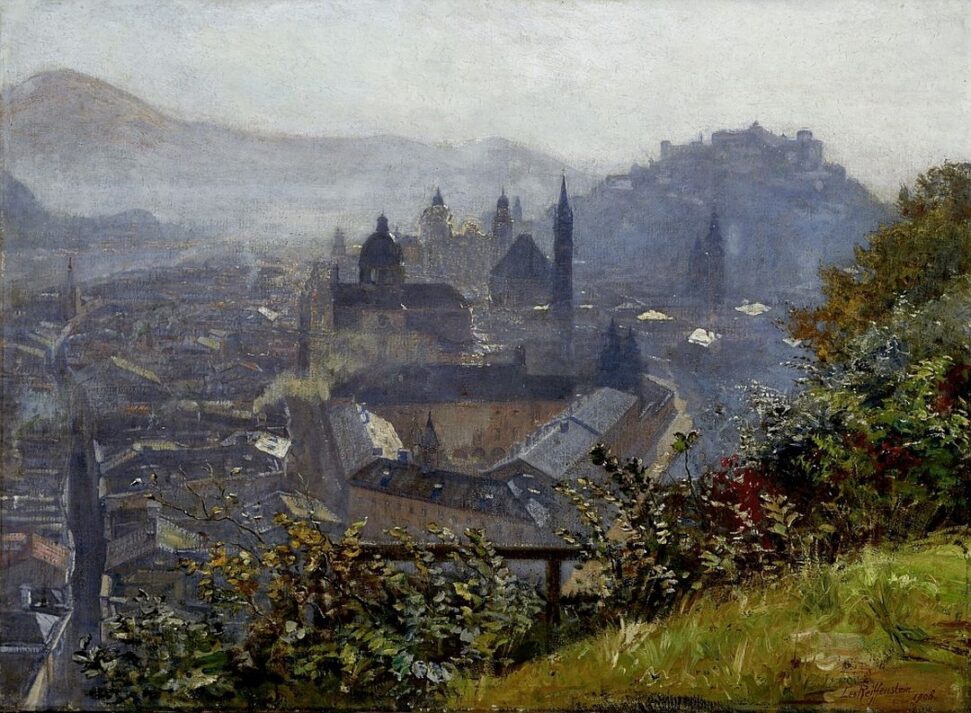
Leo Reiffenstein was a child of the Gründerzeit, the years of rapid industrial expansion in the late nineteenth century, when huge formats, bombastic themes and gloomy pomp were in vogue. His painting The Banquet of Elagabalus (1894) was a swansong of this epoch. When the era of history painting was over, he successfully turned his attention to the light-flooded world of landscape painting. His style became more buoyant and spontaneous, his palette brighter and more transparent.
This transition occurred at the same time as his move to Salzburg, and the city’s poetic transfiguration was from then on the main subject of his art. Scarcely any other painter has glorified the city’s beauties as zealously as Reiffenstein. Many of his works also pay homage to the Mozart cult.
In his fondness for dreamy moods and theatrical scenarios Reiffenstein’s romantic vein continually permeates his works. His picture of the Resurrection (1913) at the Kommunalfriedhof (Communal Cemetery) once again manifests his allegiance to the academic tradition – at a time when “Modernism” was already invading Salzburg as well.
Biography
27 July 1856 Born in Vienna as son of an émigré lithographer from Thuringia. His father runs a successful art-printing business
1871–1878 Studies at the Vienna Academy of Art. His most important teacher is August Eisenmenger, an exponent of history painting. Subsequently an assistant in the studios of Hans Makart and Heinrich Angeli
1880 Exhibition debut at the Vienna Künstlerhaus. He initially concentrates on historical themes (The Wedding Journey ofEmperor Maximilian, The Coronation of Frederick II in Palermo)
1885 Emperor Franz Joseph I purchases his genre painting Disputation
Since 1893 Resides for reasons of health in the family’s summer villa in Mondsee
1869 Moves to Salzburg. Studio in Mirabell Palace, which strongly influences his choice of motifs. From now on he mainly devotes himself to landscape painting
5 January 1924 Death in Salzburg as an honoured member of the Salzburg art scene