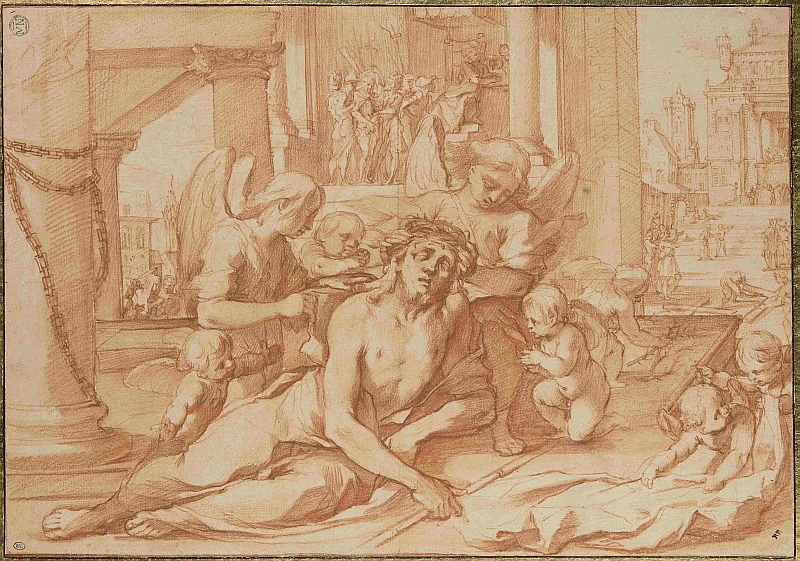
King Louis XIV acquired the art collection of the Cologne-born merchant and banker Everhard Jabach (1618–1695), who lived in Paris, in several stages. From an early age, Jabach was surrounded by works of the highest artistic quality. As a collector, he broke new ground. At a time when drawings were not yet widely regarded as independent works worthy of collection, Jabach actively sought them out. He also showed a particular appreciation for artists from his German homeland. These interests led him to assemble one of the most important collections of drawings of the seventeenth century. Jabach’s collection of 5,542 drawings formed the foundation of the Department of Graphic Arts at the Louvre (Département des Arts graphiques du Louvre). Approximately eighty of these works are presented in Salzburg as part of this exhibition.
Curatorial Statement
Everhard Jabach was a Cologne-born merchant and banker who lived in Paris. His father had already assembled an art collection, but Jabach greatly expanded it, particularly in the field of the visual arts. In doing so, he cultivated relationships with fellow connoisseurs and collectors. For example, he acquired more than one hundred paintings from the estate of Thomas Howard, Earl of Arundel, and also purchased works from the collection of King Charles I of England. Jabach collected both old and contemporary art and, in a manner that was unusual for a collector in France at the time, showed a strong interest in Northern European art, particularly works by German and Dutch artists. He devoted exceptional care and enthusiasm to his collection of drawings. Indeed, he was among the first collectors to regard drawings as a medium worthy of collecting in their own right. He personally catalogued the works, assembled them into albums, and had each drawing mounted with a narrow gold border.
The eighty drawings selected for this exhibition date from the sixteenth and seventeenth centuries and represent the three principal groups within Jabach’s collection: the Italian, Northern European, and French schools. The artists represented read like a who’s who of art history: Albrecht Dürer, Hans Holbein, Peter Paul Rubens, Ambroise Dubreuil, Simon Vouet, Nicolas Poussin, Michelangelo Buonarroti, Annibale Carracci, and Raphael, among others. The selection is complemented by works of the Premiers Peintres du Roi—the leading painters at the court of the Sun King—Charles Le Brun and Pierre Mignard. Their estates also entered the royal collection, making it possible to document particularly well the artistic taste of France during the Grand Siècle. In total, works by sixty-nine artists are presented in the exhibition.
The reasons that ultimately led Jabach to sell his collection to the king remain unclear. Three explanations have been suggested: financial difficulties, gratitude for royal favours he had received, or a desire to ensure the preservation of his collection beyond his lifetime. The acquisitions were arranged by the far-sighted finance minister Jean-Baptiste Colbert. For Colbert, investing in an art collection was also a political strategy. Likewise, although Louis XIV undoubtedly loved art, he also recognised the collection’s value as a prestigious and lasting asset.
The exhibition focuses on drawings of the Early and High Baroque periods, recounts an important early chapter in the collecting history of the Louvre, and offers visitors an encounter with two remarkable personalities who devoted their time, curiosity, and passion to the study and appreciation of drawings.