The exhibition “Daily Bread”, presented at the Monatsschlössl of the Salzburg Museum, showcases artistic works by students of Art Education in the Department of Fine Arts, Art and Craft Education at the University Mozarteum Salzburg. Created within the course Contemporary Art (supervised by Bernhard Gwiggner, Eva Jandl-Jörg, and Beate Terfloth), the works explore the theme of “figural breads and bread as a medium of creative processes up to contemporary art.” Using diverse media such as photography, video, sculpture, graphic art, and ceramics, the students reflect on bread with both irony and critical insight, revealing its many layers of meaning. Complemented by historical figural breads from the Salzburg Museum’s Folklore Collection, the contemporary works form a fascinating exhibition about a culturally unifying staple food found throughout the world.
The exhibition coincides with the 40th anniversary of the Department of Fine Arts, Art and Craft Education (headed by Dieter Kleinpeter) at the University Mozarteum Salzburg.
Curatorial Statement
The students approached the theme of bread from a variety of perspectives. Three of the artists explore, through photography and film, the questions of when, how, and why people eat bread.
Julia Jordan closely observed her family and friends, inviting them to prepare their favorite type of bread and explain when and where they eat it. Whether consumed alone or in company, as a snack or a main meal, the preparation process and ingredients were documented in a photographic series, creating a highly personal and multifaceted portrait of bread as food in contemporary Western society.
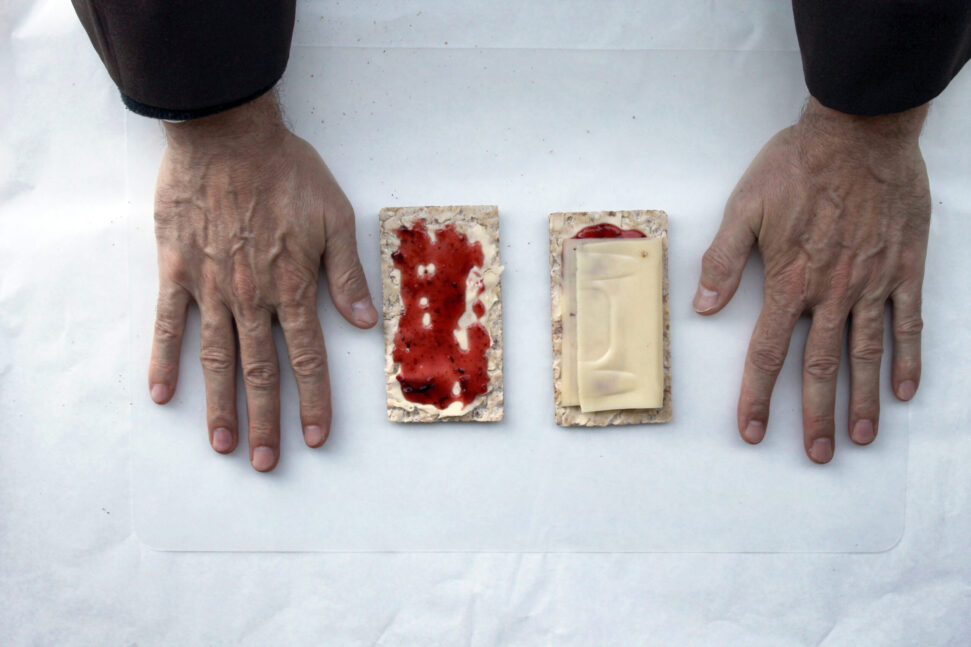
In her film work, Ines Ruhs playfully turns familiar habits upside down: meat becomes bread and bread becomes meat. Through an ironic performance, she encourages viewers to reflect on everyday conventions surrounding open-faced sandwiches and bread-based meals.
Sylvia Caba’s video work presents a world that is both sensual and absurd. At first glance, the artist appears to be kneading dough, a simple process that would normally result in a shaped loaf. Instead, the kneading evolves into an increasingly intense and wild gestural performance. Combined with the film’s soundscape, the scene gradually slips into the unreal. The work invites viewers to find meaning in apparent nonsense, leaving them perhaps puzzled, yet amused.
Johanna Schwarz approaches bread through personal associations. For her, bread evokes warmth, the aroma of fresh baking, and a sense of comfort and home. She chooses the hot-water bottle as a symbol of these ideas, transforming it into a ceramic form used to bake edible objects and spread the delicate scent of fresh bread.
Taking a global perspective, Thomas Rainer presents a metallic globe inspired by statistics on world hunger. He translates data on food scarcity into dough-based forms, altering the proportions of countries according to levels of hunger. For example, Africa shrinks to the size of Europe due to undernourishment. The result is a socially critical work that encourages viewers to consider other parts of the world and to think more consciously about food consumption.
With a touch of humor, Sarah Oswald examines historical—and today often seemingly bizarre—instructions concerning the baking of figural breads. She removes historical texts from their original context and combines them with invented stories and images. Many excerpts initially appear satirical, only for the footnotes to reveal that they are authentic historical sources once strictly observed by devout and often superstitious rural communities.
Elisabeth Scheicher addresses bread as a religious symbol of the body of Christ. She recalls how many Catholic rituals seemed strange and incomprehensible to her as a child and remain so today. This sense of alienation is expressed through a monstrance constructed from ordinary industrial baked snacks. The work also serves as a critical reflection on the Catholic Church as an institution and on the selective ways in which Christian charity is often practiced.
Rita Pöll draws on experiences from her semester abroad in Africa, where she learned to bake bread on hot stones. Combining this experience with the South Tyrolean tradition of communal eating from a shared bowl, she creates a delicate bowl-shaped bread baked over a rounded mold. During the exhibition opening, this fragile object brings visitors together around a shared act: eating collectively. Standing around a single bowl, participants engage in a simple yet powerful gesture of connection and community.