Salzburg, with its picturesque Baroque center and extensive gardens and green spaces, is world-famous. At the Panorama Museum, the city’s unique atmosphere is permanently preserved in the monumental circular painting by Johann Michael Sattler.
In 2017, Salzburg celebrated two anniversaries that are directly connected to the preservation of the city. In 1967, fifty years earlier, Austria’s first Old Town Preservation Act was passed in Salzburg. The legislation originated from an initiative by the art historian Hans Sedlmayr, who, in his 1965 book The Demolished Beauty – A Call to Save Salzburg’s Old Town, advocated for the preservation of the city’s distinctive architecture. Thirty years later, in 1997, Salzburg’s historic center was inscribed on the UNESCO World Heritage List, an achievement whose twentieth anniversary was celebrated in 2017.
As early as the nineteenth century, Johann Michael Sattler promoted the city of Salzburg abroad through his panoramic painting. Artists have always played an important role in shaping the city, as reflected in its galleries, theaters, the Salzburg Festival, and the International Summer Academy of Fine Arts. With this exhibition, we aim not only to present Salzburg’s built heritage but also to introduce several visual and multimedia chroniclers of the city through works from the museum’s collection.
Salzburg has always been more than its famous buildings. It is a vibrant city because many artists live and work here and because it possesses a highly active cultural scene. Through its World Heritage status, the city bears responsibility not only for preserving its architectural history but also for safeguarding a much broader cultural heritage, ensuring its protection and continuation for future generations.
Curatorial Concept
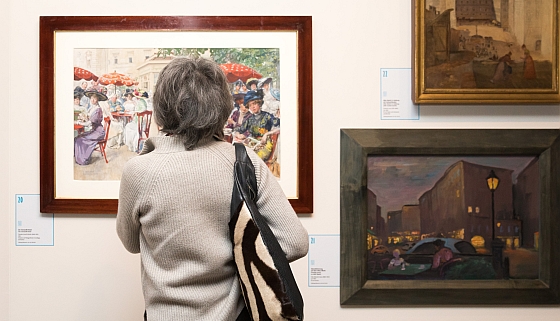
The first section of the exhibition is dedicated to the UNESCO World Heritage Site of Salzburg’s Historic Centre. To this end, six prominent locations within the city and one site in the province of Salzburg have been selected and are presented through works by renowned artists from the Salzburg Museum collection. Created between the first half of the eighteenth century and 1993 (2016), these works are by Johann Michael Sattler, Hubert Sattler, and other significant artists, including Gerhard Ertl, Theodor Ethofer, Felix Albrecht Harta, Rudolf Hradil, Georg Jung, Kay Krasnitzky, Alfred Kubin, Oskar Laske, Friedrich Loos, Karlmann Müller, Max Peifer-Watenphul, Carl Schneeweis, Jöchl/TRAGSEILER, and Matthias Klos.
The paintings and graphic works often convey entirely different impressions of the same location, while each artist’s distinctive style creates a unique atmosphere. Rudolf Hradil’s ink drawing transforms Residenzplatz into an airy and light-filled space that almost evokes the feeling of an Italian piazza. With Theodor Ethofer, visitors stroll to the Tomaselli kiosk on Alter Markt, while Friedrich Loos depicts the market stalls that once occupied the square.
This artistic walk through the city invites visitors to rediscover Salzburg’s streets and landmarks from new perspectives. The visual tour continues from Makartplatz and Domplatz to Neutor. The final stop lies beyond the city itself, in Bad Gastein. UNESCO has also taken an interest in this remarkable location, which has been artistically documented by the contemporary artist Matthias Klos.
The second section of the exhibition examines different approaches to the preservation and development of Salzburg’s historic centre through historical photographs, postcards, and graphic works from the museum’s collections. Since its introduction in 1967, the Salzburg Old Town Preservation Act has steadily increased awareness of heritage conservation, not only among political decision-makers but also among the wider public. There is broad recognition of the special care required when dealing with the historic urban fabric.
The exhibition presents six projects, each representing a different approach. These include the history of the Hotel Stein, the restoration of the University Church, and the construction of the new Alte Diakonie building alongside the listed Saullichschlössl on Imbergstraße. The “Mississippi Steamer,” a café, serves as a notable example of relatively short-lived architecture, having existed for only twenty years. By contrast, the courthouse building has stood for much longer; it is currently undergoing renovation and restoration and is being expanded with a new structure in its inner courtyard.
Considerable public debate has accompanied the new development project at Rehrlplatz. Here, contemporary architecture is being introduced into a historic and organically evolved urban environment. Opinions have differed—and continue to differ—regarding both the intended use of the project and its architectural scale. The project has also sparked protests from members of the public. Consequently, the City of Salzburg commissioned an expert assessment from UNESCO to determine whether the development is compatible with the requirements of World Heritage status. The current situation at Rehrlplatz has been artistically documented through photography by the artist collective Jöchl/TRAGSEILER.
The projects presented in this exhibition constitute a selection that illustrates the city’s development over an extended period. Architectural changes must always be viewed within their historical and temporal context. Equally important are the evolving principles of conservation ethics and the resulting changes in heritage preservation practices. The roles of political representatives, the public, and investors are also crucial.
What all stakeholders should share is the desire to preserve Salzburg’s historic core while enriching the cityscape with ambitious new projects. In doing so, future generations will inherit compelling architectural documents of our own time—structures that may themselves become worthy of preservation in the years to come.