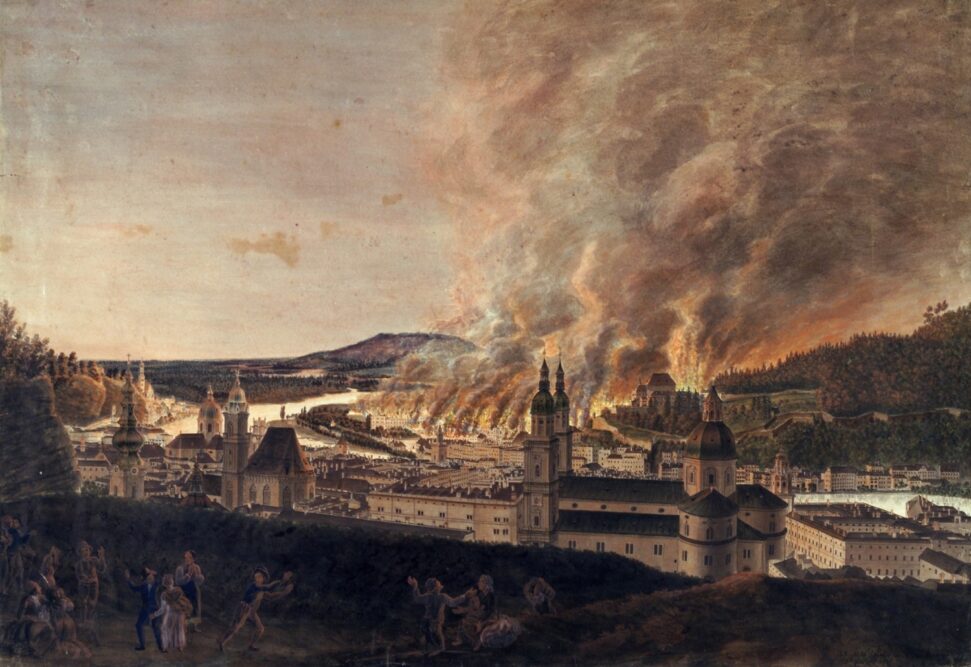
200-Year Anniversary of the Great Fire in Salzburg
28.4.2018 until 7.7.2019
Panorama Museum
About the exhibition
Brief Overview:
Two hundred years ago, a major fire destroyed numerous buildings in the Rechtsstadt district of Salzburg. On April 30, 1818, grease caught fire on a kitchen stove located in the right wing of the building complex of the Church of the Holy Trinity. In the building at Dreifaltigkeitsgasse No. 12, which was then used by the military’s Jägerbataillon, the fire spread rapidly and, fueled by wind and dry conditions, spread to the adjacent shingle roofs toward the right side of the old town. The flames engulfed the row of houses on the left side of Linzergasse. Additional buildings all the way to Paris-Lodron-Straße and Mirabell Palace also caught fire.
Historians Dr. Erich Marx and Dr. Peter F. Kramml (City Archives) have taken the 200th anniversary of this devastating fire disaster as an opportunity to initiate a comprehensive publication featuring numerous authors. The origins of the fire and its consequences are examined, as are the subsequent urban planning implications for the city.
The exhibition on the theme of fire also highlights historical fires in the province of Salzburg and the surrounding area. Using smaller communities as examples, it showcases other fire disasters, such as the one in St. Johann im Pongau, where children playing with fire caused a major blaze in 1855.
Curatorial statement:
The first section of the exhibition “The 1818 City Fire and Its Consequences” at the Panorama Museum follows the themes of the publication. We showcase various sites affected by the catastrophic fire through historical engravings, watercolors, a city model from 1799, photos, and videos. Using examples of buildings such as Mirabell Palace and the now-defunct Hexenturm, the Getreideschranne, and the Carabinier Stables, the exhibition highlights the urban planning changes in the city from 1818 to the present day. While these changes are not always directly attributable to the fire, they were certainly influenced by it. Visitors learn about the history of the buildings, details of the fire damage they sustained, and the resulting consequences. Sometimes demolition was the more cost-effective option, but often the houses were repaired. The disaster prompted a thorough review and revision of the city’s building codes. As a result, the use of wooden shingles in the city of Salzburg, among other things, was banned.
The second part of the exhibition focuses on the topic of fires in the Salzburg region and its surroundings, such as the neighboring Rupertiwinkel. As the population density increased in the 18th and 19th centuries, large-scale fires became more frequent even in rural areas. For this reason, the citizens of towns and villages increasingly established their own fire departments. These initiatives became increasingly necessary as the use of open flames in industry—such as in salt works and other trades—caused the risk of fires to rise dramatically. This exhibition explores the emergence of fire departments and their cultural significance in society, as well as the element of fire, which, alongside its useful properties and importance in tradition, can also have devastating effects.