Picture Stories for Salzburg
24.2.2017 until 6.11.2017
DomQuartier | North oratory
About the exhibition
Brief Information
These three painters each influenced Salzburg in different ways during the Baroque era. Johann Michael Rottmayr, born in Laufen – then part of Salzburg – produced his first frescoes in the Alte Residenz. Paul Troger came from Habsburgian South Tyrol and began his artistic career in Salzburg with the dome fresco in St. Cajetan’s Church. And the Lower Austrian Martin Johann Schmidt, known as Kremser Schmidt, supplied all altarpieces for St. Peter’s Abbey, with two exceptions.
The exhibition focuses on the oil paintings that were created for Salzburg or found their way into Salzburg museums. Besides information on patrons and installation locations, the exhibition aims to provide in-depth information first and foremost on the iconography of the pictures.
The exhibits were among the selection of Baroque masterpieces that were on show from October 2016 until January 2017 in the exhibition “Geste baroque” at the Louvre.
Curatorial Statement
The artworks presented in this exhibition were recently shown as Baroque ambassadors of Salzburg in the exhibition Geste baroque. Collections de Salzbourg at the Louvre. Unlike in Paris, where a highly international audience was introduced to the distinctive characteristics of Salzburg and Austrian Baroque art and its principal representatives, the Salzburg presentation offers the opportunity to examine the significance of these works within the context of Salzburg’s artistic development in the late seventeenth and early eighteenth centuries.
At the heart of the exhibition are the oil paintings that these three artists created for Salzburg. In addition to presenting factual information such as date, technique, patronage, and original location, particular attention is given to the content and meaning of the images themselves.
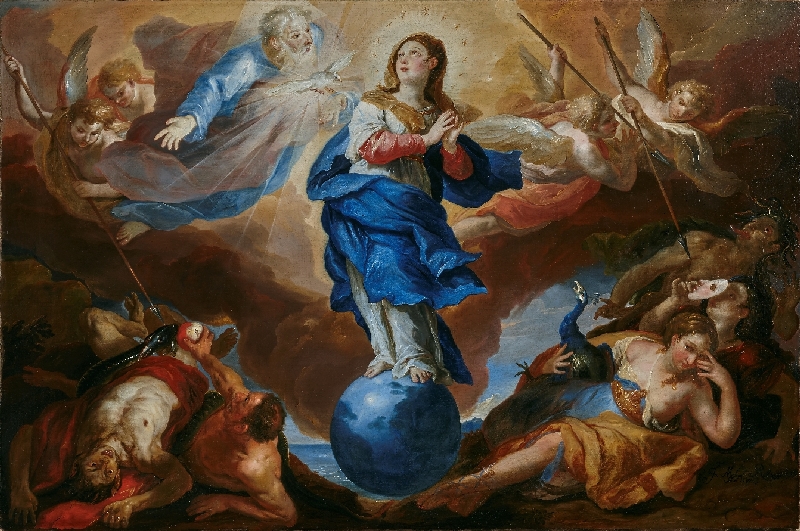
In 1697, Johann Michael Rottmayr was commissioned by Prince-Archbishop Johann Ernst Count Thun to create at least two paintings for the council chamber of the Residence. In contrast to Rottmayr’s frescoes for the Residence, these works deal with religious subjects: the Immaculata—the Virgin Mary conceived without original sin, a theme of special importance to Salzburg and particularly to the University of Salzburg—and Christ among the Doctors. Both paintings also contain references to the Mysteries of the Joyful Rosary. How does Rottmayr visualize a mystery of faith? How does he depict emotional suffering and joy, or a heated scholarly debate involving a twelve-year-old boy? What role does colour play in conveying these themes?
A second council chamber, this time in the civic town hall, received two so-called Allegories of Justice painted by Paul Troger in 1749. The commission was granted by Salzburg’s mayor, Kaspar Wilhelmseder (c. 1681–1755). Measuring 186.5 × 268 cm and 182 × 265 cm respectively, these works rank among the largest paintings in the museum’s collection. The two Old Testament scenes, Daniel Defending Susanna and The Judgement of Solomon, depict exemplary acts of justice and therefore earned the designation “justice paintings.” Through colour, gesture, and facial expression, Troger conveys an atmosphere of tension fluctuating between accusation and defence, slander and insight, innocence and confession of guilt. His depictions of the execution of judgement become almost tangible. The Judgement of Solomon, in particular, has entered common parlance as a symbol of wise adjudication. The origins of the story can be traced to India, from where it spread through China; one version of the narrative later inspired Bertolt Brecht’sThe Caucasian Chalk Circle.
The third protagonist of the exhibition, Martin Johann Schmidt, known as Kremser Schmidt, was commissioned by Abbot Beda Seeauer to design the high altar of the Abbey Church of St Peter, completed in 1778. Two preparatory designs for this commission have survived. They reveal not only the particular interests of the patron but also provide insight into the saints depicted, their lives, legends, and attributes. The furnishing history of St Peter’s Abbey Church offers an excellent opportunity to explore the concept of the Gesamtkunstwerk, or “total work of art,” in which architecture, painting, sculpture, and decoration are conceived as a unified artistic whole.