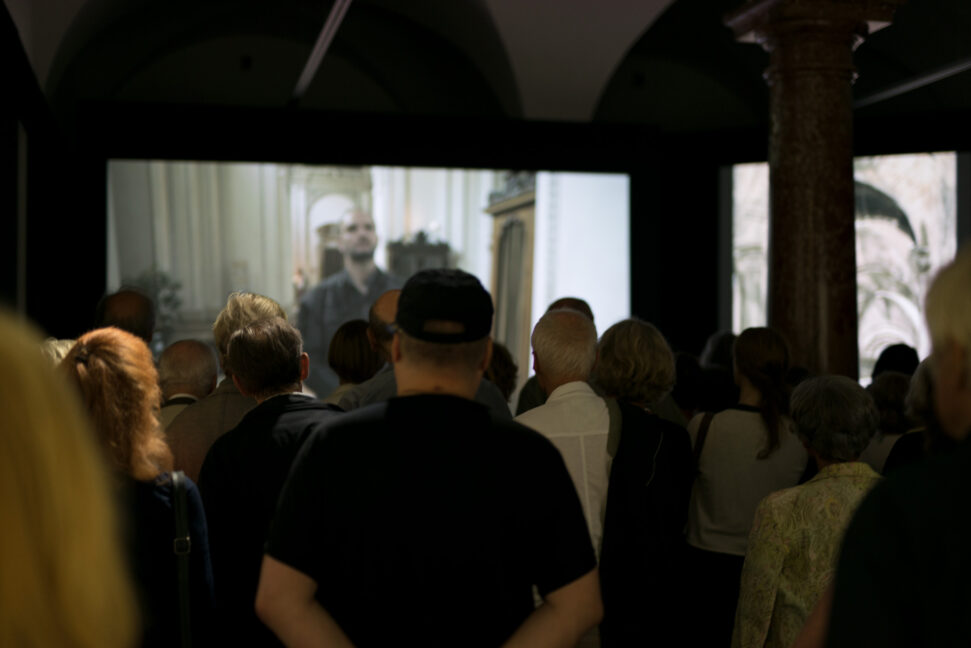
As an art-historical experiment, this exhibition project embarks on a search for traces of Albrecht Altdorfer’s connection to Salzburg. In addition to exploring hypotheses concerning the artist’s biography and possible links to the region, the project primarily investigates whether Altdorfer’s landscape depictions can be associated with the actual topography of Salzburg.The exhibition is conceived as a visualisation of ongoing research and scholarly inquiry. To this end, it brings together selected works by Altdorfer alongside a wide range of supporting materials, photographs, and documents. Through this combination of artworks and research evidence, the exhibition offers insight into the process of investigation itself and invites visitors to engage with questions of attribution, interpretation, and artistic geography.
Curatorial Statement
The former State Archaeologist of Salzburg, former Director of the Salzburg Museum, and renowned Hallein expert Dr. Fritz Moosleitner has devoted many years to the study of Albrecht Altdorfer’s oeuvre, driven by a particular interest in topography. His extensive knowledge of the Salzburg landscape formed the basis for identifying elements of Salzburg’s topography within Altdorfer’s paintings and graphic works. These references appear in both religious compositions and landscape scenes: sometimes as individual mountain silhouettes, sometimes as dominant motifs filling an entire landscape painting, and sometimes only in details such as views through windows. Cityscapes, landscape features, and even entire mountain formations can be recognised in Altdorfer’s works. On the basis of these observations, Moosleitner reconstructed several stays by Altdorfer in Salzburg—visits that have not previously been documented in the artist’s established biography. While a stay in Mondsee around 1500 is historically documented, no written evidence exists for visits to Salzburg itself. However, the landscapes depicted by Altdorfer are rendered with such precision and specificity that they are unlikely to have been based merely on sketches made during a single brief visit. Rather, they appear to be the result of repeated observation and sustained engagement with the actual landscape. This interpretation raises intriguing questions about Altdorfer’s relationship with Salzburg and offers new perspectives on both his artistic practice and his biography.
Biography
Albrecht Altdorfer was born around 1480 in either Landshut or Regensburg and died in Regensburg in 1538. Little is known about his biography, particularly regarding his early years and artistic training.
In 1505, he acquired citizenship in Regensburg. There, he first served as a member of the Outer Council from 1517 and later joined the Inner Council in 1526. As an envoy of the city, he travelled to Vienna in 1535 to meet Emperor Ferdinand I.
Among Altdorfer’s most important works are the Battle of Alexander (Alexanderschlacht), now in the Neue Pinakothek in Munich, and the St Sebastian Altarpiece in the Abbey of St Florian, Upper Austria. After 1520, Altdorfer began creating pure landscape paintings, establishing himself as one of the first artists to treat landscape as an independent subject in its own right rather than merely as a backdrop for religious or historical scenes. This development marks a significant milestone in the history of European painting.