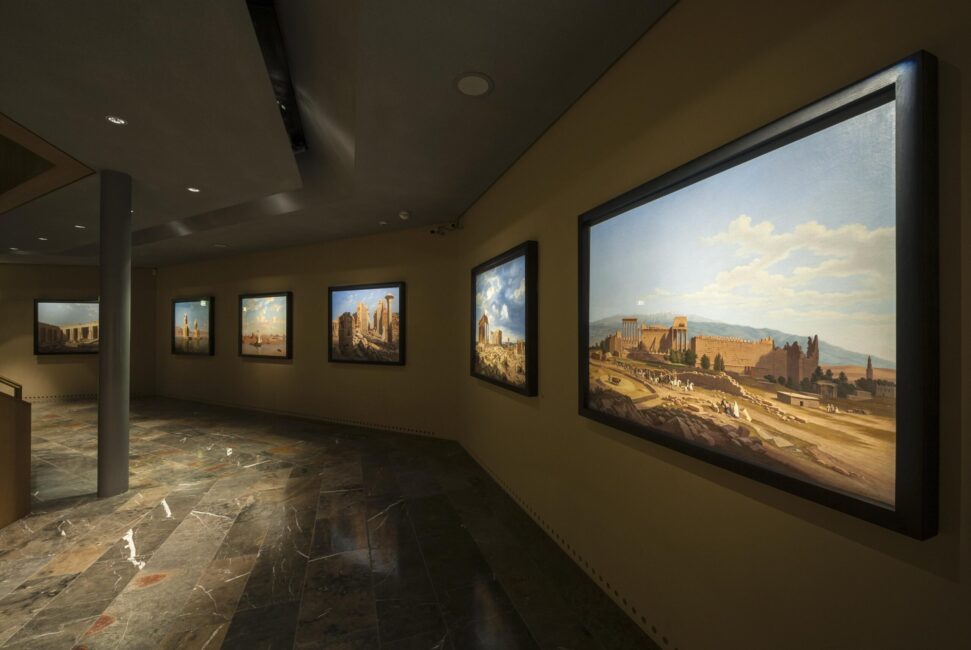
Since the reinstallation of the Salzburg Panorama in 2005, a series of Cosmorama exhibitions has presented paintings devoted to themes such as Metropolises, Mountain Worlds, Salzburg, The Orient, The Oceans of the World, and Deserts. These have now been followed by exhibitions focusing on Archaeology and Contested Sites. In recent years, the Cosmorama paintings of Hubert Sattler have experienced a remarkable increase in appreciation. This development is all the more striking given that, until not long ago, they were often dismissed as outdated curiosities. Like panoramic paintings, however, they belong to the precursors of modern mass media, marking a transition from the age of aristocratic patronage to a new form of public entertainment accessible to a broader audience.
The Cosmoramas were conceived as visual spectacles for curious and inquisitive viewers. What visitors saw was accompanied by detailed explanations and commentaries that expanded upon the images. The illusionistic effect, originally enhanced through optical viewing devices, transported audiences to the most distant regions of the globe. Between 1840 and 1870, Hubert Sattler exhibited his travel paintings in numerous cities throughout Europe. From 1850 to 1852, he toured the United States, where his presentations enjoyed considerable success. Through these works, audiences were offered a vivid visual experience of places they would otherwise never have had the opportunity to see, combining education, entertainment, and a sense of wonder in a uniquely nineteenth-century form of visual culture.
Archaeology
During the first half of the nineteenth century, archaeology emerged as an independent academic discipline, encompassing a range of specialised fields such as prehistory, classical archaeology, and Egyptology. Spectacular archaeological discoveries, made accessible through richly illustrated expedition reports, captured not only the interest of scholars but also the imagination of a much wider public. At the same time, prestigious excavation projects and the display of archaeological finds in museums became important instruments of imperial self-representation, particularly among the competing European great powers. Archaeological discoveries were not only scientific achievements but also symbols of national prestige and cultural influence.
Hubert Sattler’s Cosmoramas depicting archaeological sites also bear witness to an early wave of tourism that brought the historical monuments of the Mediterranean world and the Americas within reach of travellers. Destinations that had once been accessible only to adventurous explorers and researchers increasingly became attainable for the educated middle and upper classes. In 1841, during the very period in which Sattler undertook his journeys, the British entrepreneur Thomas Cook pioneered the concept of the organised package tour. Sattler’s Cosmoramas occupy a fascinating position between several worlds. They function simultaneously as precise documentary records, artistically enhanced landscape representations, and early forms of tourist promotion. In this sense, they serve as intermediaries between scientific observation, artistic interpretation, and the emerging culture of modern travel, offering nineteenth-century audiences both knowledge and visual excitement while stimulating their desire to explore distant places themselves.
Contested Sites
Hubert Sattler’s Cosmoramas are generally characterised by the conspicuous absence of war. His works elevate the landscape into a privileged and illuminated position. Conflict, combat, and warfare are not central themes in his depictions; instead, he focuses on the topographical features and distinctive characteristics of the places portrayed. Nevertheless, occasional references to the historical and military significance of these locations can be found in Sattler’s accompanying commentaries. Presented in conjunction with the exhibition “War. Trauma. Art. Salzburg and the First World War,” this display brings together sites that are embedded in collective memory and public discourse as places of conflict. These locations were contested not only in a military sense but also as arenas of religious, political, and economic confrontation.
By juxtaposing Sattler’s often serene and picturesque representations with the complex histories of the places depicted, the exhibition invites visitors to reflect on the relationship between landscape, memory, and conflict. It explores how places that appear peaceful in visual representation may nevertheless bear witness to centuries of struggle and competing claims, and how historical narratives continue to shape contemporary perceptions of these sites.