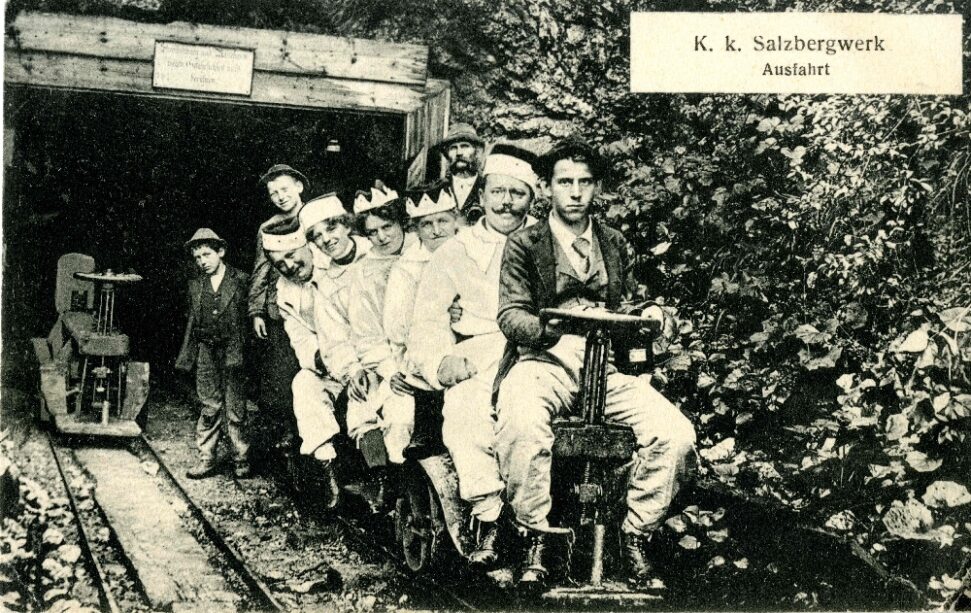
The special exhibition focuses on the eventful history of salt mining on the Dürrnberg and the saltworks site of Hallein. Since the Salzburg prince-archbishops reopened and developed the salt deposits around 1200, the economic success of salt production depended largely on access to markets and on technological innovation. Because the lives and livelihoods of the people of Hallein were closely linked to the salt industry of the Dürrnberg, fluctuations in demand and technological advances repeatedly brought about profound social and economic changes.
The exhibition is divided into several sections, each structured around key historical turning points and periods of transformation. On the ground floor, the history of salt production and saltworks administration is traced across eight centuries. Historical highlights illustrate developments ranging from Hallein’s emergence as a town in the early thirteenth century to the closure of the saltworks in 1989.
Particular attention is given to the flourishing period of salt production under Prince-Archbishop Wolf Dietrich von Raitenau around 1600, as well as to Hallein’s incorporation into the Habsburg Empire in 1816. The exhibition also explores the opening of the mine tunnels to visitors from 1617 onward and the later transformation of the saltworks site into a tourist destination during the twentieth century.
The section on the second floor is devoted to the Griesrechen, a remarkable structure that played a crucial role in the transport and storage of timber required for salt production. This large timber-catching installation was essential to the operation of the saltworks. Historian Wolfgang Wintersteller has examined both its historical function and the subsequent reuse of the site, providing new insights into this fascinating aspect of Hallein’s industrial heritage.