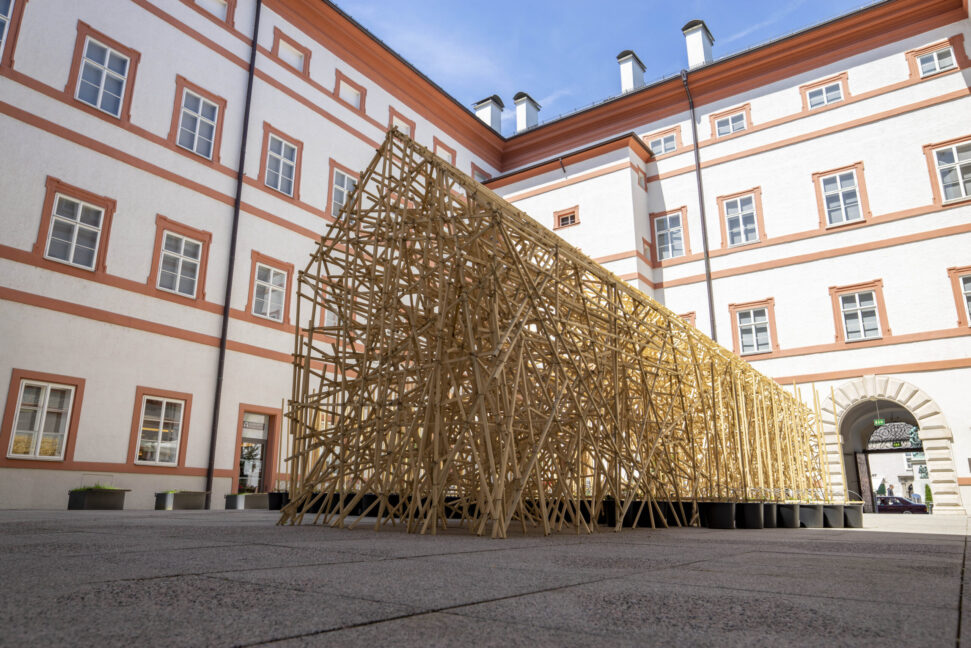
To mark the 100th anniversary of the Salzburg Museum Association, artist Wilhelm Scheruebl (born in 1961 in Radstadt) has created an installation in the courtyard of the Neue Residenz. “Oikos” is the title, which in ancient Greece stood for a household and community, the dwelling, and the economic enterprise, thereby describing a cosmos, a world in miniature. In its original sense, this refers not only to the building, but also to the families and the servants or slaves, the furnishings, and the associated land. A woman presides over this cosmos—the men are off making politics!
Conceptually, the title and the work focus on responsibility for oneself and for one’s relationships with others. The house, in its many forms, has been a constant presence in Wilhelm Scheruebl’s life for a very long time. The house is a symbolic center, a place of birth and death, but also a stable anchor in life from which one can make sense of one’s existence and to which one always returns. This is also expressed on a linguistic level, where the house always stands for a community, such as the “House of Europe,” but terms like “home birth” or “dwelling” also carry more meaning than just that of a building. The plants that accompany the house are the “non-static element”—the house as a controlled fixed point, the plant as a longer-term, changing phase of time. Scheruebl’s works are not meant to last forever. They are defined by becoming and passing away, by an evolving flow of time that can be subsumed under the concept of vanitas. The observation of nature, the changing light, the shifting of the seasons—this transformation is evident in the sunflowers, which not only change over the course of the growing season but also daily through heliotropism, thereby representing a direct connection to the sun, the giver of life.