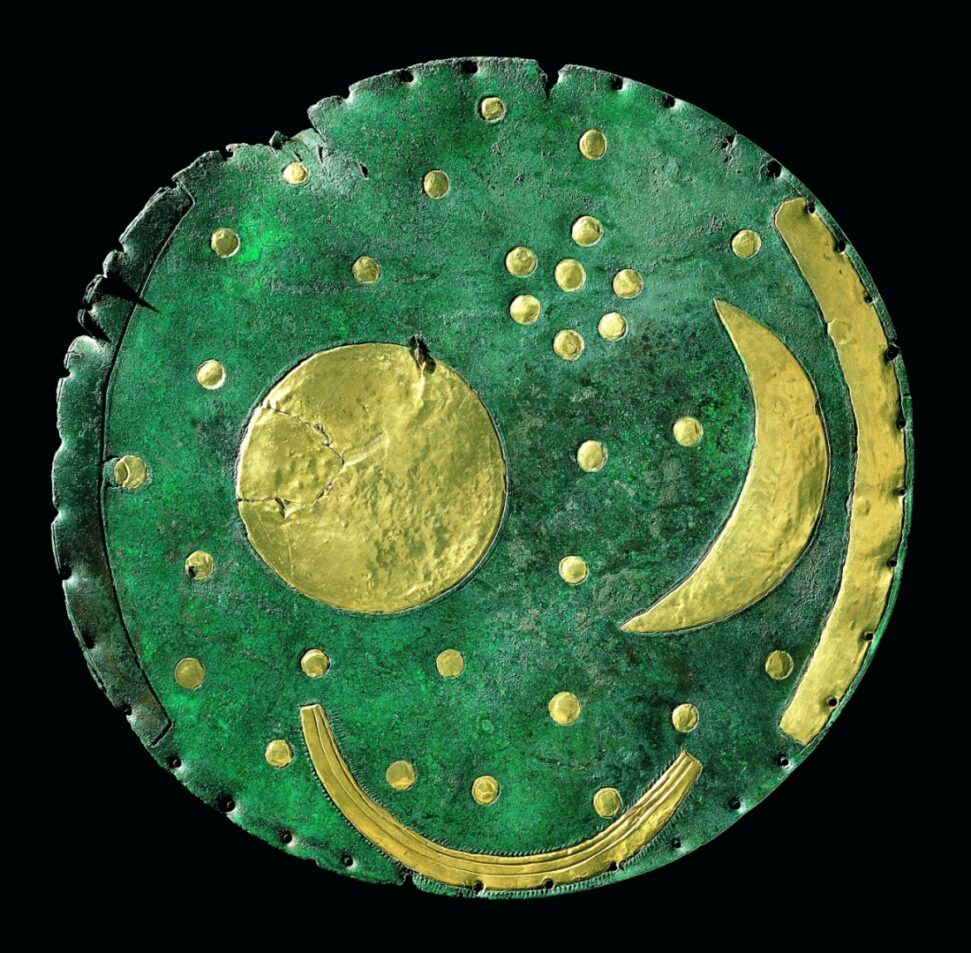
During the Bronze Age, in the 2nd millennium B.C., the Salzburg region was the center of the world. The copper deposits of the Mitterberg mining district around Bischofshofen supplied large parts of Central Europe with this very valuable raw material and it led to the region’s economic prosperity. The world-famous “Nebra Sky Disk,” which was buried in the ground around 1500 BC in Saxony-Anhalt, 600 km away, is also made of Mitterberg copper. In a special exhibition in cooperation with the “Arche Nebra” exhibition center, the journey of copper is traced from the deposit to the north, from raw material to finished product. It depicts the fascinating world of Bronze Age mining with original finds from the tunnels of the copper district and presents the astronomical and ritual secrets of the Nebra Sky Disk.
Curatorial Statement
The Nebra Sky Disk, discovered in 1999 by illegal looters in the center of the German state of Saxony-Anhalt, is one of the most spectacular objects of European prehistory. The flat copper disk is decorated with gold inlays depicting celestial bodies, the sun and moon, as well as boat-shaped objects. The form and arrangement of these inlays suggest that it is a realistic and accurately measured representation of the night sky around 1500 BC. The crescent moon, its relationship to the solar disk, and above all the constellation of the Pleiades indicate that the Sky Disk was used as an astronomical instrument for determining precise calendar dates. After this function came to an end, it was used for a period as a cult object and was eventually deposited in the ground together with other objects. Modern archaeological and scientific analyses of the Sky Disk have demonstrated that it was made from copper originating from the mining district around Bischofshofen in the Austrian state of Salzburg. Since the beginning of the Bronze Age around 2000 BC, this region had produced the highly sought-after raw material used throughout Europe for manufacturing weapons, tools, implements, and jewelry. The Mitterberg mining district is therefore regarded as one of the most important mining centers in Europe, where economic strength, political power, and military influence were concentrated. The combination of these socio-economic factors is vividly reflected in the hoard discovered at Pass Lueg, where the world-famous helmet, mining tools, and raw materials were deposited together along an important trade and transportation route.
The discovery site of the Nebra Sky Disk and the origin of its raw materials demonstrate that the network of Bronze Age elites extended across vast distances. It likely also served as a channel for the spread of technological innovations, intellectual concepts, and ideas. The exhibition aims to explore these patterns of long-distance contacts and to present how economic, social, and ideological exchange took place between geographically distant societies of Bronze Age Europe. In this way, the journey of copper—from the ore deposits of the Inner Alps to the finished cult object and astronomical instrument—can be traced and understood. The advanced state of technology at that time is reflected both in the complex mining and ore-processing techniques of the Mitterberg mining district and in the sophisticated mathematical and astronomical knowledge embodied in the Sky Disk. As specialized knowledge reserved for the ruling classes, both components served as instruments of power and control for Bronze Age elites.