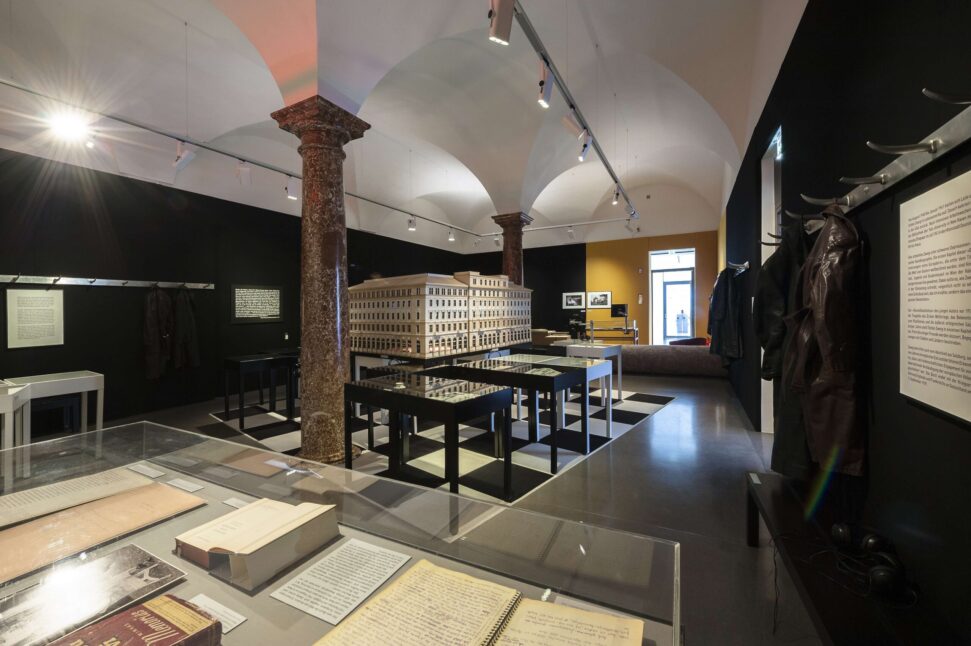
At the centre of the exhibition is the last work that Stefan Zweig was able to complete: the famous The Royal Game (Schachnovelle). It was Zweig’s final manuscript, which he delivered to the post office in Petrópolis just one day before his suicide.
The story takes place aboard a passenger ship travelling from New York to Buenos Aires. On board, two very different figures encounter one another: the world chess champion Mirko Czentovic and the Viennese lawyer Dr. B.. Fellow passengers, enthusiastic about chess, arrange a match between the two, and the unexpected occurs: Dr. B. defeats the world champion.
But who is Dr. B.? In the novella’s embedded narrative, he recounts his life story. In March 1938, he was arrested by the National Socialists and imprisoned for months in Vienna’s former Hotel Métropole, which had become the headquarters of the Gestapo. There he endured repeated interrogations and complete isolation. From the coat pocket of a guard, he managed to steal a book about chess. Using it, he taught himself the game and eventually began playing against himself. This obsessive mental activity gradually pushed him into a delusional state. During one of his psychological breakdowns, he damaged property in his cell and severely injured his arm after smashing a glass panel in a corridor. Whether this act may have been a suicide attempt remains uncertain; many prisoners sought to escape the brutal torture methods employed by the Gestapo in the building.
While recovering in a hospital, Dr. B. is assisted by a doctor and succeeds in fleeing Austria. Yet even after finding refuge in exile, the trauma of imprisonment remains with him. Following his unexpected victory over Czentovic on the ship to Argentina, a second game must be abandoned when Dr. B. relapses into the psychotic state he himself describes as his “chess madness.” Though he has escaped persecution, he cannot escape the psychological consequences of his ordeal.
The Royal Game is the only work of fiction in which Stefan Zweig directly addresses the contemporary political realities of Austria. In the scenes set within the formerly luxurious Hotel Métropole—transformed after March 1938 into the Vienna Gestapo headquarters and a site of brutal torture—Zweig created a literary memorial to the victims of fascism.
A model of the hotel, which was demolished after the war, forms part of the exhibition. Documents, photographs, and film excerpts explore the history of this place of terror. Several display cases present typescripts, first editions, and archival materials relating to Chess. Visitors can also view excerpts from the 1960 film adaptation starring Curd Jürgens and Mario Adorf, and listen to passages from the novella through audio stations.
A Brazilian documentary film featuring interviews with contemporary witnesses and acquaintances from Zweig’s years in Brazil provides additional insight into his final period of life.
At the entrance to the exhibition, visitors are reminded of Zweig’s connection to Salzburg. A large photograph of his house on the Kapuzinerberg is accompanied by quotations from letters in which he lamented the growing atmosphere of antisemitism in the city.
Further display cases are devoted to themes that played an important role during Zweig’s years in exile, including his friendship with Sigmund Freud, his collaboration with Richard Strauss, his commitment to a united Europe, and his efforts to assist Jewish refugees. A number of personal documents—from his passport to his farewell letter—are also on display, offering intimate insights into the life of one of the twentieth century’s most important writers in exile.