1967 was a year of upheaval and new beginnings, and not only within the student protest movement. While Pierre Boulez provocatively called for opera houses to be blown up, Herbert von Karajan was developing his own visionary concept of music theatre through the founding of the Salzburg Easter Festival. Karajan intended nothing less than to incorporate the “sum of his life experiences” into his production of Wagner’s Ring for Salzburg. To realise this vision, stage designer Günther Schneider-Siemssen created a monumental ring-shaped ellipse for the Festival stage, into which he placed a mighty ash tree trunk. The result was a “timeless” staging concept with a utopian dimension, suspended within a “cosmic space.” Within this setting, Karajan conjured what was described as a “sound of often painful beauty.”
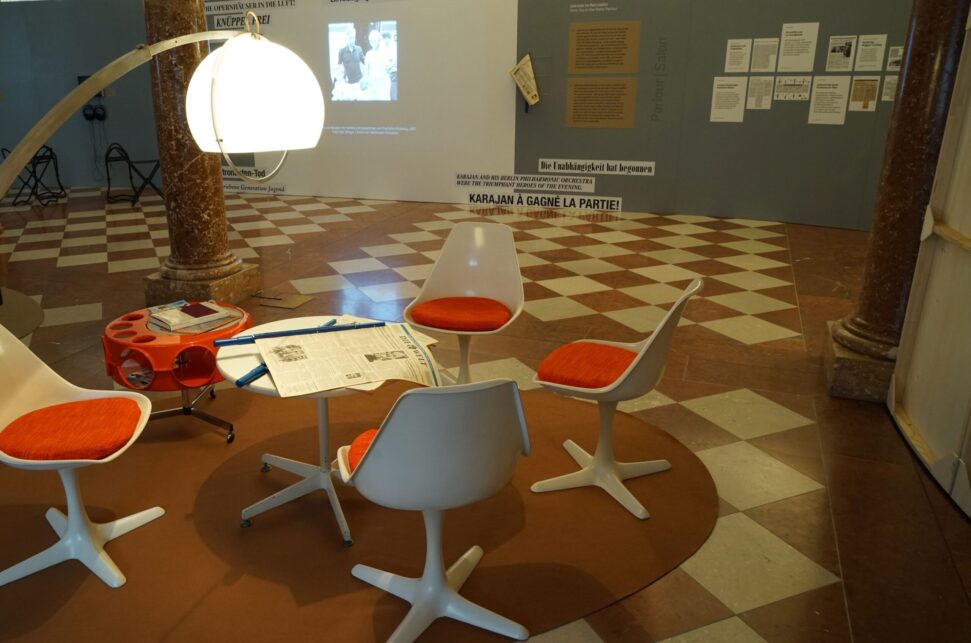
The fiftieth-anniversary recreation of the stage designs for Die Walküre brings this historic production back into focus. Accompanying the reconstruction, the exhibition (curated by Margarethe Lasinger) traces, retells, and makes visible and audible Karajan’s concept of the “Fest-Spiel”—the festival performance as a total artistic experience. By juxtaposing historical and contemporary perspectives, the exhibition invites visitors to reflect on changing modes of seeing and listening. It explores how perceptions of opera staging have evolved over time while creating a rich sensory experience that makes past and present worlds of artistic perception tangible and accessible.